 By Breaking News Reporter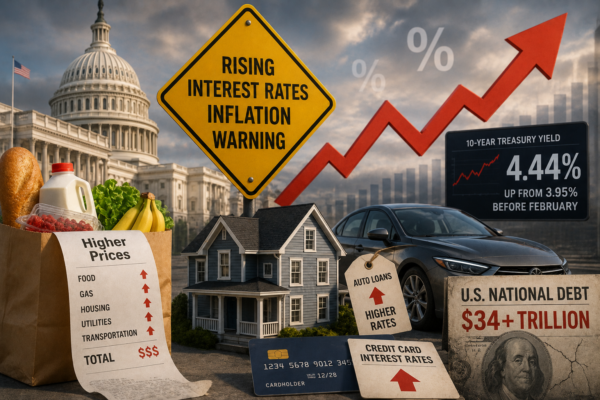
An inflation warning is beginning to take shape as rising interest rates create new challenges for American families, businesses, and policymakers. While inflation itself remains a major concern, economists are increasingly focused on another problem that could make everyday life even more expensive: the growing cost of government borrowing.
Recent market activity shows investors demanding higher returns before lending money to the U.S. government. As a result, Treasury yields have climbed significantly, pushing borrowing costs higher across the economy. The trend is affecting mortgage rates, auto loans, credit cards, and other forms of consumer debt.
For many households already struggling with high prices, this latest inflation warning could add another layer of financial stress.
Interest Rates Continue to Climb
One of the clearest signs behind the inflation warning is the rise in long-term interest rates. The yield on the 10-year Treasury note has increased noticeably in recent months, driven by concerns about inflation, government debt levels, and global economic uncertainty.
Higher Treasury yields often ripple throughout the economy. Mortgage lenders, banks, and financial institutions use Treasury rates as benchmarks when setting borrowing costs for consumers.
As rates rise, homebuyers face larger monthly payments, while businesses encounter higher financing costs for expansion and investment projects. The result can be slower economic growth and reduced consumer spending.
Government Debt Draws Increased Attention
Another factor contributing to the inflation warning is concern over the nation’s growing debt burden. The federal government continues to run substantial budget deficits, adding trillions of dollars to the national debt over time.
Economists warn that servicing this debt has become significantly more expensive. Interest payments alone now consume a growing portion of federal spending, leaving fewer resources available for other priorities.
Many analysts believe investors are becoming increasingly cautious about long-term government borrowing. While there is still strong confidence in the United States economy, some market participants are questioning how quickly deficits can be reduced under current policies.
This inflation warning reflects growing concern that higher borrowing costs may persist for years rather than months.
Trump Administration Defends Its Strategy
Donald Trump has repeatedly stated that his administration has a plan to reduce budget deficits. The White House has pointed to several potential sources of revenue and savings, including tariffs, spending reductions, fraud prevention efforts, and stronger economic growth.
Administration officials argue that eliminating wasteful spending could significantly improve the nation’s financial position. Treasury Secretary Scott Bessent recently suggested that large amounts of fraudulent government spending could potentially be removed from future budgets.
However, many economists remain skeptical. They argue that reducing deficits will likely require a combination of spending restraint, economic growth, and difficult policy decisions that extend beyond identifying fraud or inefficiencies.
The ongoing debate has fueled the inflation warning being discussed by financial experts across the country.
Higher Rates Affect Everyday Americans
The inflation warning is not limited to economists and financial markets. It is increasingly affecting ordinary Americans making major financial decisions.
Mortgage rates have climbed to some of their highest levels in months, making homeownership more expensive for many buyers. Families shopping for vehicles are also facing higher financing costs, contributing to slower auto sales.
Credit card interest rates remain elevated as well, creating additional challenges for households carrying balances. For consumers already dealing with elevated food, energy, and housing costs, higher borrowing expenses can significantly impact monthly budgets.
These pressures are becoming an important issue for voters as lawmakers prepare for upcoming elections.
Political Implications Grow
The inflation warning is also creating new political challenges. Democratic candidates have begun highlighting the issue as they campaign for congressional seats, arguing that persistent deficits and rising borrowing costs are making life less affordable.
Some candidates are focusing on how higher interest rates affect homebuyers, small businesses, and families trying to manage everyday expenses. They contend that fiscal responsibility should play a larger role in future policy decisions.
Republicans, meanwhile, argue that economic growth and spending reforms will help improve the nation’s long-term financial outlook. The debate is expected to remain a major topic as election season approaches.
Global Factors Add More Uncertainty
The inflation warning extends beyond U.S. borders. Rising interest rates are affecting countries around the world as investors reassess inflation risks and government debt levels.
Recent geopolitical tensions, including conflict involving Iran, have contributed to higher energy prices. Increased fuel costs often feed into broader inflation pressures because transportation and production expenses rise throughout the economy.
At the same time, governments worldwide are investing heavily in emerging technologies such as artificial intelligence. While these investments could boost productivity in the future, they also require substantial amounts of capital today.
These combined factors are creating an environment where interest rates may remain elevated longer than many economists previously expected.
Financial Markets Are Watching Closely
Despite concerns, investors continue to show confidence in many areas of the American economy. Stock markets have generally remained resilient, reflecting optimism about business growth and innovation.
However, bond markets are sending a different message. Rising yields suggest investors are demanding greater compensation for lending money over long periods.
Economists say markets may ultimately force policymakers to address deficit concerns if borrowing costs continue climbing. Financial markets often react quickly when confidence begins to weaken, making debt sustainability an issue that cannot be ignored indefinitely.
This inflation warning serves as a reminder that trust plays a critical role in the global financial system.
Moving Forward
The coming months could prove important for both policymakers and consumers. Rising interest rates, growing debt concerns, and global economic uncertainty have combined to create an inflation warning that many experts believe deserves close attention.
While the U.S. economy remains strong in many areas, higher borrowing costs have the potential to slow growth and place additional pressure on household budgets. Whether through spending reforms, economic expansion, or other policy changes, leaders will face increasing pressure to address these concerns.
For now, the inflation warning remains a central issue shaping discussions about the economy, government finances, and the financial future of millions of Americans. As interest rates continue to influence everything from mortgages to business investments, the impact of these developments will likely be felt well beyond Washington.