 By Breaking News Reporter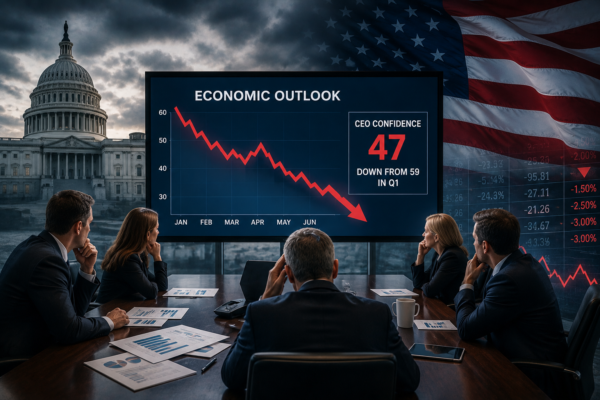
Corporate leaders across the country are becoming increasingly concerned about the direction of the US economy, according to a new survey that shows confidence among chief executives has fallen sharply in just three months.
The latest CEO Confidence Survey from The Conference Board and The Business Council found that business leaders have shifted from optimism to caution as economic growth slows and uncertainty increases. The findings suggest many executives believe the economy in the United States could face additional challenges during the second half of 2026.
CEO Confidence Falls Into Negative Territory
The survey of 141 CEOs revealed that confidence dropped significantly during the second quarter. The overall confidence score fell from 59 in the first quarter to 47 in the second quarter. Any reading below 50 indicates that negative views outweigh positive ones.
Only 15% of CEOs said the US economy is better today than it was six months ago. That figure is down sharply from 39% in the previous survey. Meanwhile, 47% of respondents said the US economy has worsened during that same period, compared with just 8% who held that view three months earlier.
The rapid decline highlights growing concern among business leaders who are responsible for making critical investment and hiring decisions.
More CEOs Expect Conditions to Worsen
Looking ahead, many executives are not expecting quick improvements. Forty percent of CEOs believe the US economy will worsen over the next six months. In the previous quarter, only 13% expected weaker conditions.
Economists say this shift in outlook reflects concerns about slowing growth, persistent inflation pressures, geopolitical instability, and tighter financial conditions. While the US economy has continued to expand, many business leaders believe growth is losing momentum.
Conference Board Chief Economist Dana Peterson noted that CEOs now view the US economy as materially weaker than it was six months ago and expect additional deterioration in the months ahead.
Slowing Growth Raises Concerns
Recent economic data has added to the uncertainty. The Bureau of Economic Analysis reported that gross domestic product grew at an annualized rate of just 0.5% during the final quarter of last year. The figure came in below economists’ expectations and highlighted the slower pace of expansion within the US economy.
Although the nation recorded overall growth of 2.1% for 2025, many analysts believe the US economy faces stronger headwinds entering 2026. Rising global tensions and higher energy prices have created new risks that could affect consumer spending and business investment.
Some economists warn that inflation could remain elevated while economic growth slows, creating difficult conditions for both businesses and households.
Hiring Plans Begin to Shift
The changing outlook is already affecting workforce decisions. Companies are becoming more cautious about hiring as uncertainty surrounding the US economy increases.
According to the survey, 31% of CEOs expect to reduce their workforce during the next six months. That figure now exceeds the 28% who plan to expand hiring. The findings suggest businesses are preparing for a period of slower activity within the US economy.
Many companies are also scaling back wage increases. Planned raises are increasingly concentrated within the 3% to 4% range as executives focus on managing costs.
At the same time, 53% of CEOs reported experiencing hiring challenges in at least some areas of their organizations, demonstrating that labor market pressures have not completely disappeared despite growing concerns about the US economy.
Business Risks Continue to Grow
Beyond economic growth, executives identified several risks that could affect their industries in the coming months. Cybersecurity emerged as one of the most significant concerns, with nearly two-thirds of CEOs ranking cyber threats among their top risks.
Geopolitical tensions also remain a major issue as global conflicts continue to create uncertainty. Many leaders worry that international instability could place additional pressure on the US economy through higher energy prices and disruptions to global trade.
Artificial intelligence and emerging technologies were also listed among the leading concerns. While many businesses see opportunities in AI, executives remain cautious about the risks associated with rapid technological change.
Supply chain disruptions and energy-related challenges increased in importance during the latest survey, adding further pressure to the outlook for the US economy.
Investors Remain Optimistic Despite Warnings
Interestingly, the growing concern among executives contrasts with the performance of financial markets. Major stock indexes have continued to reach new highs even as business leaders become more cautious about the US economy.
Some analysts argue that markets may be underestimating economic risks. Others believe investors are focusing on long-term growth opportunities rather than near-term economic weakness.
Still, the survey suggests corporate leaders are preparing for a more difficult environment. Their concerns about the US economy are influencing decisions involving hiring, wages, and future investments.
What Comes Next with the US Economy?
While the survey does not guarantee an economic downturn, it offers an important look into how business leaders view current conditions. CEOs often have early insight into shifts in demand, spending patterns, and industry trends.
The latest findings indicate growing uncertainty surrounding the US economy and suggest many companies are taking a more defensive approach. As economic data continues to emerge throughout the year, policymakers, investors, and consumers will be watching closely to see whether these concerns become reality.
For now, confidence among corporate America has weakened considerably, signaling that many executives believe the US economy could face a challenging road ahead.