 By Breaking News Reporter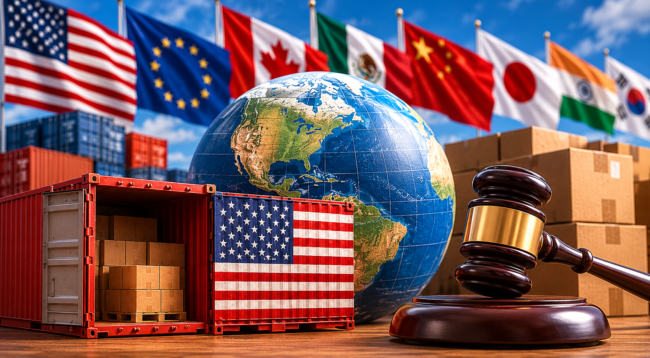
President Donald Trump is moving forward with a major trade proposal that could affect imports from more than 60 countries around the world. The plan would impose new tariffs on a wide range of goods entering the United States, with the administration arguing that stronger action is needed to address concerns about forced labor practices in global supply chains. If approved, the proposal would represent one of the most significant trade actions of Trump’s second term and could have far-reaching effects on businesses, consumers, and international relations.
New Tariff Rates Target Major Trading Partners
According to the Office of the US Trade Representative, imports from countries including Canada, Mexico, the European Union, Taiwan, and the United Kingdom would face a new tariff rate of 10%. Meanwhile, products imported from China, India, Japan, South Korea, Brazil, and Switzerland would be subject to a higher tariff rate of 12.5%.
The proposal stems from a Section 301 investigation that examined how trading partners address goods allegedly linked to forced labor. US officials determined that countries with stronger policies against forced labor imports would receive the lower tariff rate, while nations viewed as having weaker enforcement would face higher duties. The Trump forced labor tariffs proposal is designed to encourage governments to strengthen labor protections while creating what the administration views as fairer conditions for American workers.
Administration Says Workers Need Protection
The Trump administration argues that foreign producers using forced labor gain an unfair advantage over businesses that follow labor standards. Officials say American workers are placed at a disadvantage when competing against products that may be produced under lower labor costs tied to abusive practices.
US Trade Representative Jamieson Greer said the administration intends to address what it considers a long-standing imbalance in global trade. Supporters of the proposal believe the Trump forced labor tariffs could help reduce reliance on questionable supply chains and encourage companies to source products more responsibly.
As part of its investigation, the USTR cited findings connected to the Trafficking Victims Protection Reauthorization Act of 2005, identifying dozens of products and supply chains that may involve forced labor inputs. The review highlighted items such as cotton used in clothing production, critical minerals used in solar products, fish products, and palm oil-related materials.
Global Reaction Arrives Quickly
The announcement generated immediate responses from several major economies. China rejected the allegations behind the investigation and criticized the proposed tariffs. Japanese officials stated they remain in contact with their US counterparts regarding the issue, while leaders in the European Union described the proposal as unjustified.
Australia also expressed concerns, arguing that tariffs on its exports would conflict with existing trade agreements. India’s commerce ministry confirmed it remains engaged in discussions with the United States regarding the matter. Despite the criticism, the administration appears determined to continue advancing the Trump forced labor tariffs process.
Trade experts say the proposal could trigger additional trade disputes if affected countries decide to pursue retaliatory measures. However, many governments have recently chosen negotiation over retaliation when responding to US trade actions, leaving open the possibility of new agreements before any tariffs take effect.
Businesses Face New Uncertainty
Many business organizations are warning that the proposal could create new challenges for companies operating across international supply chains. Because the tariffs would apply to more than 60 economies, importers may face increased compliance requirements and uncertainty about future costs.
The International Chamber of Commerce noted that applying a single investigative framework across such a large number of countries could create complications for businesses trying to navigate different trade rules and sourcing requirements. Companies that rely heavily on imported materials may need to reevaluate suppliers or absorb additional expenses if the tariffs are finalized.
The Trump forced labor tariffs proposal arrives at a time when many businesses are already dealing with elevated transportation costs, inflation concerns, and ongoing geopolitical tensions.
Financial Markets Watch Closely
Investors reacted cautiously to the announcement. While US stock futures remained relatively stable following the news, European markets experienced some weakness, particularly among major automakers. Companies that depend heavily on international trade could face additional pressure if higher tariffs lead to increased costs or reduced demand.
The proposal also comes during a period of heightened uncertainty for the global economy. Ongoing geopolitical conflicts and elevated energy prices have already raised concerns about inflation. Additional tariffs could add another layer of complexity for policymakers trying to balance economic growth and price stability.
Some economists believe the Trump forced labor tariffs could contribute to higher prices on certain imported goods if businesses choose to pass increased costs on to consumers.
Exemptions Included in the Proposal
Not every product would be affected by the proposed tariffs. Several important exemptions have been included in the framework. Food products such as beef, tomatoes, bananas, coffee, and orange juice would remain exempt. Certain fuels, chemicals, and metals already covered by existing trade measures would also avoid the new tariffs.
In addition, some apparel and textile imports could qualify for reduced tariff rates through quota arrangements tied to US textile exports. These exceptions are intended to limit disruptions in key industries while still advancing the administration’s trade objectives.
What Happens Next?
The tariffs are not expected to take effect immediately. The proposal must first go through a public comment and review process. Written comments are due by early July, and public hearings are scheduled to begin shortly afterward. Feedback from businesses, trade groups, foreign governments, and other stakeholders could influence the final version of the policy.
For now, the Trump forced labor tariffs proposal represents a major escalation in the administration’s broader trade agenda. With dozens of countries affected and billions of dollars in trade potentially impacted, the outcome of the review process will be closely watched around the world. Whether the tariffs ultimately reshape supply chains, improve labor standards, or spark new trade disputes remains one of the biggest questions facing the global economy in the months ahead.